

Why Doesn't My Algorithm Want Me To Watch 'The Comeback'?
Probably because this final season's commentary on AI is too real

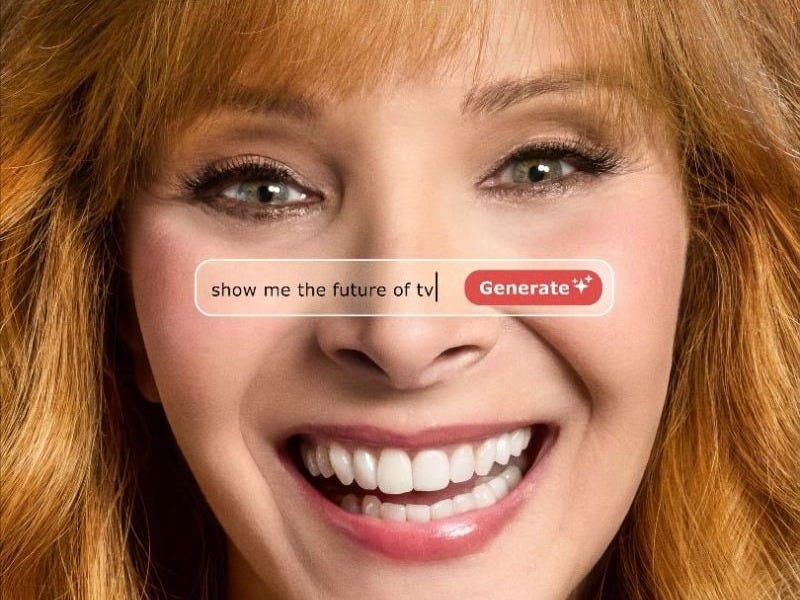
Every so often someone will ask me, “Where do you write?” It’s a perfectly normal question that increasingly makes me feel like Valerie Cherish in the newly released third season of The Comeback: trapped in an industry that demands constant visibility while eliminating the conditions that made creative work possible in the first place.
No one is surprised when you mention a Substack today, but when I started this newsletter in 2020, it was this impulsive thing that I did out of necessity coinciding with the pandemic: restaurants were closed, travel was on hold, and I suddenly found myself without a job or purpose.
At the time, Substack was a blank canvas and a digital vessel, a pragmatic holding tank for content I had nowhere to put until hopefully being picked up at yet another outlet. Six years later, I am still locked into a personal branding situationship as a writer constantly terrified of losing relevancy by being pigeonholed without a proper elevator speech. “It’s not about weed or witches, but it’s also not-not that.” I guess I could stand to be a little more strategic.
As the platform has evolved, I’m always wondering if I’m “doing the right thing” and using it “the right way” when just doing it was the point. But the fact this is now the de facto branding tool for notable writers and celebrities, and a publishing arm for traditional media outlets, points towards deeper issues in the attention economy likely doomed to crash out again.
This period of digital limbo that many writers are finding themselves in started nagging at me while watching the newly released third and final season of The Comeback—Lisa Kudrow’s satire about problematic, washed up actress, Valerie Cherish, still chasing her pipe dreams and holding onto delusions of Hollywood grandeur through a poorly conceived reality television series. Despite premiering just two months ago, I still had to go looking for it myself because my HBO algorithm doesn’t seem interested in showing it to me. I wonder why?
More than twenty years after the show originally premiered in 2005 — and over a decade after its 2014 revival — the newest season somehow feels even more relevant in the AI era as a dark commentary on the impact of AI in the entertainment industry. It’s an exhaustion shared by writers and creatives across all industries increasingly forced to justify their worth against nascent technology built on plagiarized works and user-generated content. Every step towards standardization and automation seems to be another step away from originality and authenticity.
In the show, Valerie is an aging actress operating from the lens of the industry of a different era that she’s been losing her grip on as “a woman of a certain age.” To maintain that hold, she latches onto the trend of making a documentary shot cinéma vérité (except not really because she wants to look good in every shot).
Much has changed since the show premiered in 2005 and rebooted in 2014, which is where we pick up two decades later as Valerie, faced with low job prospects, unwittingly gets sucked into being the face of the first AI show. Operating under an NDA, she’s not allowed to discuss the AI component with anyone, including the cast and crew, convincing herself every step of the way that nothing is her fault as everything around her falls apart. Even her Emmy becomes symbolic as a literal broken achievement of reality.
Courting back her original cinematographer and producer, Jane, who is now working at a Trader Joe’s, Valerie enlists the talents of a Gen Z assistant named Patience to help with social media as a lazy attempt to throw pasta at anything that might keep her relevant. It’s the fundamental disconnect among older generations who opted into an unsustainable investment opportunity while expecting a younger, tech savvy generation to help them, and are now shocked to find it biting them in the ass.
In The Comeback, the showrunners exist mostly as babysitters for “Al” — the name they have given their AI — as they bleed the project for a quick paycheck, leaving every episode hanging increasingly by a thread as inexperienced and inept staffers are forced to pick up the slack as the inefficiencies of AI begin to crack under the pressure of reality.
It feels like déjà vu for Millennials who graduated in 2008 only to be expected to take on the unpaid jobs of four different people, hoping it would get their foot in the door only to be handed a title that once carried meaning but now feels unearned.
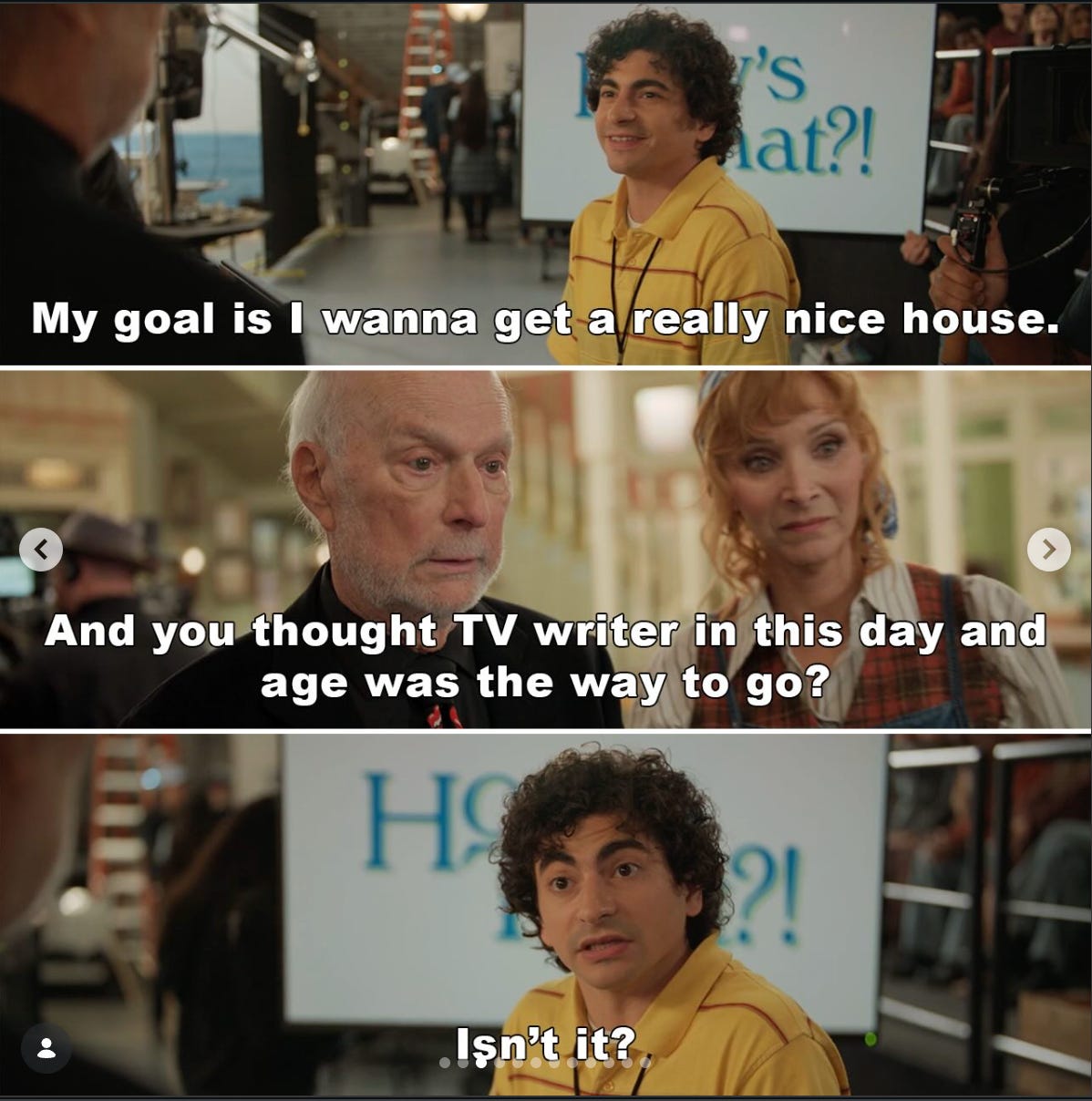
Here’s the thing about writers: most of us value the art of collaboration — even the antisocial introverts. Everything from print magazines to television are a byproduct of unseen collaboration, with rates that have dropped rapidly over the past two decades to below minimum wage thanks to meaningless click-through rates.
Today, that collaboration feels nearly impossible as the talents of many are frequently siloed into an army of one. Everyone from publishers to producers are no longer looking for greatness, but “good enough.” The burnout is palpable, overwhelming, and demoralizing, leaving many wondering when ‘enough’ will finally be enough and whether we’ll ever be ‘enough’ — especially now that we’re contending against generative AI. Very rarely do you see community in the writing industry anymore, particularly now that social media has made us less inclined to champion one another lest we choose wrong.
The writing industry as a whole has always been very toxic, cut throat, and exploitative. Going into this industry meant fighting for it a little, requiring putting up with and engaging with toxic behavior for the sake of getting ahead and/or having a story for later. At the same time, these flaws were still part of a lived experience. Without it, everything just become a hollow copy of a copy of a copy.
The Comeback addresses that, too, as veteran SAG-AFTRA and WGA actors and writers start taking stock and try to right-size their past behavior as part of the collective pushback. There’s an unmatched authority and confidence from the veterans who clearly know the industry inside-out and don’t have the time or interest to fuck around with creatively inferior technology or the people who champion it. Suddenly, everyone is ready to put aside the bullshit that made them hate working and get back to the love of work.
This current era of AI feels like the natural progression of industries long focused on monetizing content that values volume over craft. AI has increasingly crept into every facet of technology whether you like it or not, with data centers hoarding our natural resources thanks to backroom handshake deals that no one seems to be able to stop. Today, it’s rare to find a digital platform that isn’t trying to be everything all at once. The difference is that AI is being sold as a way to do it faster and easier so that instead of doing everything, you’re doing nothing at all.
Even Substack isn’t just a newsletter anymore, but a multi-platform, omni-channel experience that includes a whole social media channel and video capabilities. By design, it wants to categorize and pigeonhole you, while pushing towards individual monetization. Not only has this been restrictive, but it’s also feeling a little like a low- to no-paying work obligation I never asked for by insisting that I become “a brand.” The most successful creators on Substack often lament that they’re working very hard for very little reward as the popularity of this model has compromised every project into an independent crowdsource funding opportunity.
It’s not that I don’t know how to create a focused publication, I just didn’t want to. In fact, my entire strategy was geared toward organic experimentation and highlighting people who found success without boxing themselves in as a reaction to years of losing my voice and thoughtfully researched pieces for Amazon monetization and SEO strategy. Over the years, I found myself adapting versatility over specialization, eventually earning the generic, unromantic title of “generalist.” I hated it.
Back in the day, magazines were curated based on trusted tastemakers. Magazines would drive us to bookstores or happily invest in subscriptions to read cover-to-cover, generating enough revenue to generously support features that could elevate a writer’s brand to household name. Even locally, it was still possible to sustain magazines worth reading and the team of individuals it required to produce one.
These experts would drive consumer decision-making, from which stores we shopped at to the music we listened to, that pushed us into the real world. If your voice was distinctive and worth its weight, there was a real likelihood of being plucked into a major publishing house that could offer a legitimate career or morph it into something even greater as an author or screenwriter. There used to be cachet in working at places that offered the illusion of being operationally and editorially independent, where designated ad space was ad space and editorial was editorial.
Thanks to e-commerce and metrics, everything is now an ad. We receive personalized recommendations taking away the whimsy of discovery, while digital content is often a lazy cut-and-paste job from a press release and overseen by someone too inexperienced to exercise editorial judgment and discretion. Algorithm-driven experiences are often so individualistic that we’re out of touch with larger culture and so force-fed that many have become wary and suspicious of psyop marketing. Technology is obviously the biggest driver of this cultural shift.
I would be a liar if I said I didn’t use AI, or even appreciate some of the ways it helps me as a writer. Today, you can’t even type an email or finish a document on Word without an AI prompt, adding to the overall sense of surveillance culture and convenience that I can’t stand but doesn’t seem to bother people as much as it should— just like it doesn’t bother Valerie until she’s finally impacted. It’s a pretty common mindset shared by anyone who isn’t directly profiting from AI: not a problem until it becomes your problem.
On a basic level, I can see the usefulness of AI for writers like a treadmill for runners: a tool to get back on the road. While you can technically run the length of marathon, without the lived experience of foot to pavement against shifting winds, elevation, and drive to outpace other runners, there’s nothing respectable or honest about claiming to be a marathon runner any more than someone using AI to churn out a novel and calling themselves a novelist. AI just has way more environmental and ethical issues than running on a conveyer belt.
Maybe that’s why I love this season of The Comeback so much. It forces us to ask, “Why do we need writers?” and “Do we really need AI?” The idea of comparing my writing and worth against code is demoralizing, but also insulting.
Trained editors can spot plagiarism because they’re readers. If you’re cheating, it will show. I tend to use AI as a framework for digesting and organizing transcripts, as well as copyediting — even though I would much prefer a copyeditor. But the canned nature of AI has been encouraging me to embrace the authentic and unpolished knowing the authenticity is not having copyeditor to redline everything.
At the end of the day, most writers want to feel like their words matter. They hope their words are good enough to pay their bills, take care of their families, and have access to health care when they need it. Writers of all kinds usually still love the creative challenge and reward using their brains. I’m still rooting for writers in the fight against digital brutalism. There’s no denying talent: AI can’t craft a joke as well as a comedian, insert the sensory details of something it has never experienced, or capture the emotional undercurrent of moments it has never lived.
Ironically, if my AI has any confirmation bias, it’s towards championing humanity. More frequently I find myself turning off the machine that made me doubt myself and taking the risk of getting back on the road. When we rely less on convenience, it improves our intuition and brings us back to reality, allowing us to take the risk of engaging with one another, learning new things, strengthening our insights, and inspiring us to try harder. My algorithm didn’t guide me to The Comeback, but finding my own way to the human-produced show helped me find my own creative drive again.
MORE ON PIPE DREAMS
So, AI is Standardizing Groping at Airports Now
I Used Chat GPT To Write an Essay About Weed Witches and This is What it Produced
In Praise of Gen-X Women (and Other Gen-X People)